Do you teach rules and formulas that students can follow, but are frustrated by students forgetting the rule or formula?
You notice that your students can follow the procedures, but don’t understand them. Perhaps its that they don’t understand the mathematics that makes the procedure work.
I’ve noticed this many times! I’ve taught the rule and then thought: “why are students mixing it up?” or “why don’t they remember the rule?” “How come students can learn that multiplication makes whole numbers bigger and division makes whole numbers smaller, but then struggle when the maths doesn’t fit that rule?”
Well, I’ve learned that if students don’t have the conceptual understanding of the why’s and how’s of the rule or formula the whole foundational understanding is flawed. If we rush the learning, the foundation is weak, cracks form and later learning can be impacted.
No teacher wants their students to struggle. Everyone wants to set their students up for success. Now and in the future.
Often, well meaning teachers want to tell their students the answers when students don’t understand. Teachers understandably want students to make those conceptual leaps, but doing the mathematical thinking for students isn’t the same as creating space for them to make the connection.
Instead, let’s investigate the rule and provide students a structured opportunity to investigate why the rule works.
This is why I’ve built bounded investigations to explore the mathematics behind the rules.
Don’t remove the struggle.
Structure the struggle.
Then explicitly consolidate the mathematics.
Bounded Investigations begin with a rich mathematical task. Boundaries and constraints are applied to direct students towards particular mathematical patterns, relationships, or conceptual ideas.
The mathematics isn’t left to chance.
The boundaries are intentional.
Students still have space to explore, represent, reason, test and explain their thinking — but the investigation has a clear mathematical purpose. It’s not open-ended for the sake of being open-ended. The investigation is bounded by the mathematical intention.
Take doubling.
We can teach students their doubles facts.
We can teach them that doubling is the same as multiplying by 2.
But knowing the relationship isn’t necessarily the same as understanding it.
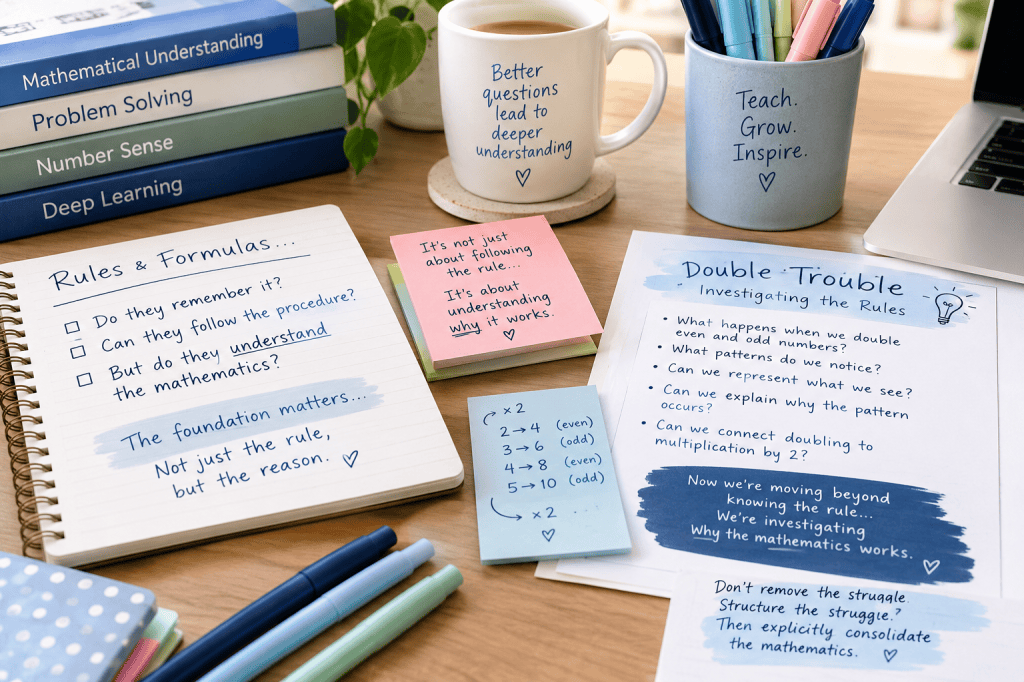
But what happens when we ask students to investigate what happens when we double even and odd numbers?
What patterns do they notice?
Can they represent what they see?
Can they explain why the pattern occurs?
Can they connect doubling to multiplication by 2?
Now we’re moving beyond knowing the rule. We’re investigating why the mathematics works.
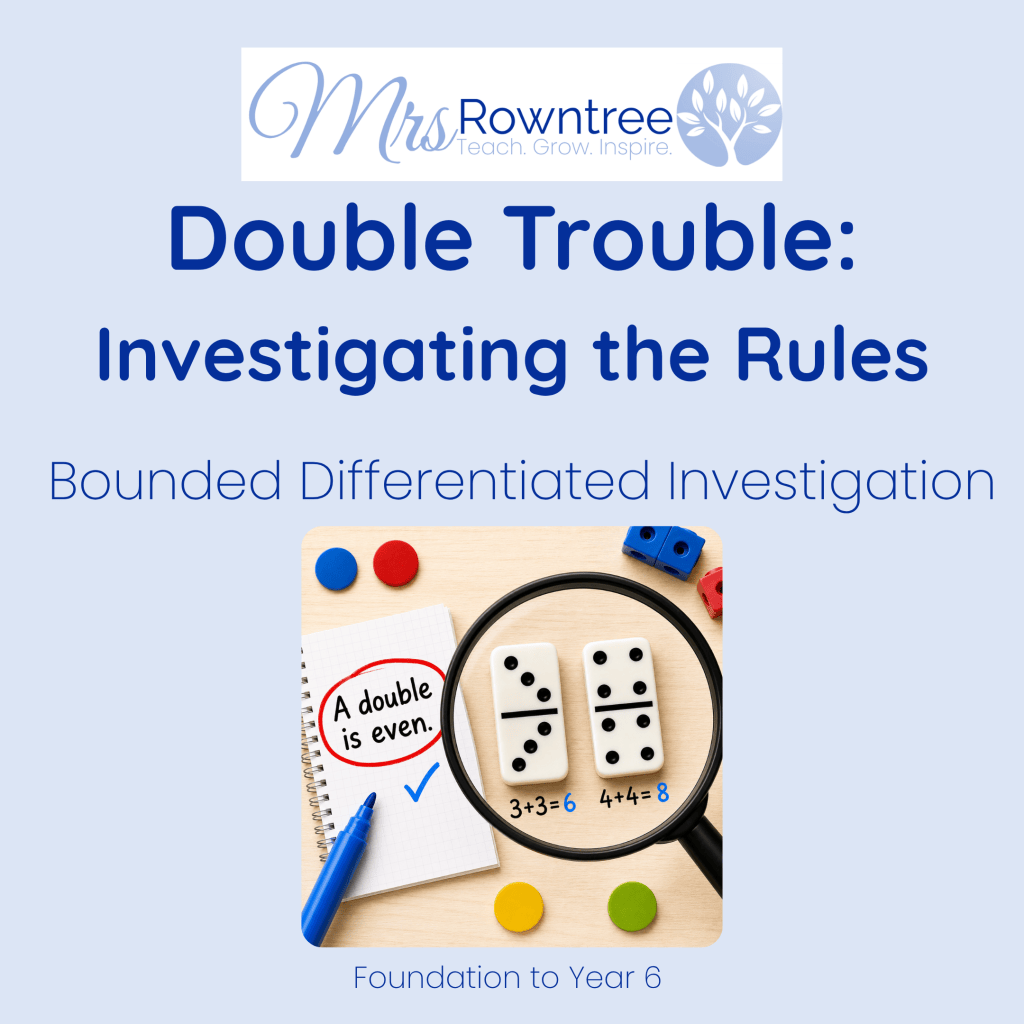
And that’s where Double Trouble: Investigating the Rules begins…
Written with love, because I care about you and your students!
Explore my resources:
Teachers Pay Teachers — Mrs Rowntree – Primary Maths

 Mrs Rowntree
Leave a comment