Mrs Rowntree

Teach. Grow. Inspire.

  • Teaching Maths & Best Practice!

    There seems to consistently be so much debate around the best practices in Math teaching. We can always seem to find research that supports different pedagogies, but what if at the end of the day it all resolves around teacher judgement, teacher skillsets, within particular contexts and within diverse student cohorts. Class complexities include an array of influences such as class size, behaviour needs, EAL/D students, mixed-year classes, and even school priorities which require teacher judgement, multiple pedagogies and balance.

    There is still so much value in explicit teaching and I love explicit teaching. I love it because it is clear and concise and supports everyone, but I also love problem based-learning because it allows students to apply learnt strategies with depth. Same goes for project based learning and maths inquiry, however I am also a strong believer in clarity around outcomes. If the outcomes are clear then the direction of the learning is clear and so to is the guidance and accumulation of skills and strategies. That way, learning doesn’t get “fluffy”, it is not by chance that students learn the skills and it certainly is not up to the student to direct learning in its entirety. Kids don’t know what they don’t know. How do they know the next steps if they don’t know the content or possibilities? Teachers still have to direct the next steps and this might look like adjustments, scaffolds, flexible groupings, or tiered tasks. We must note that the value and the learning in lots of these various instances can be profound!

    Teachers draw on their professional judgement to decide when to use explicit instruction, when to shift into inquiry, and how to balance both based on the curriculum goals and the needs of the class. A balancing act that all teachers consistently grapple with! The questions and judgements begin to roll in: Is this the right way forward, is it too soon, do I have enough time, how long do I need for the next unit, will it all fit, is my plan clear enough, what else do they need, have we covered the content in enough depth…

    It takes a lot of planning to be clear, concise and on track. Simplified programs and learning progressions look easy and they look like they took no time at all, but they take extensive time to collate. These plans and units are by far very intentional, very well thought out and very time consuming. The lessons and units are meant to look easy, be easy to teach and designed to be as easy as possible for children to grasp the concepts. Yet, to get the time to truly collaboratively plan every maths unit clearly & concisely and to a high standard is super hard. It takes me & other curriculum content creators quite some time to plan out units and design lessons. Thoughtful sequencing, intentional fluency loops and balanced pedagogy are signs of high-level teacher skill, opposite of just “following a program”.

    Considerations are so important to integrate cyclic learning so that learnt skills remain in the mind and are not forgotten. Practise and fluency are super important and time also needs to be allocated to fluency. Teaching isn’t about who has the best idea, or who has the fanciest way of teaching, or even who has the most engaging lesson, it’s about pedagogy, passion and persistence. Reteaching and fluency integration are also required, so that skills and strategies remain in the memory for children to recall.

    So the next time you are looking at various “best practices”, remember that you have great skills to teach the content if you have the passion to improve your pedagogy. Plan to reteach, plan to work on fluency, plan to improve. Once you have completed your unit, know that there is still fluency work to be done, it’s not all over and ticked off at the end of a unit. Continue to teach the maths, continue to show up for your students and continue to improve.

    Teachers are incredibly capable, they have great intentions and they must trust their judgement within their contexts. Go and be amazing at your maths teaching, check in and learn from your colleagues and remember, if you would like some units check me out at https://teachbuysell.com.au/store/Mrs-Rowntree

  • Connecting More & Reducing the Marking Load!

    Feeling buried under assessment lately? Between endless marking, data entry, and generating purposeful feedback, it’s easy to lose sight of what is really needle moving for students’ learning. Over the years, I’ve found ways to make assessment more meaningful and manageable, especially in maths lessons.

    It’s so easy to feel overwhelmed by assessment! I’ve worked in continuous reporting systems and I’ve even made precious time in my lessons for students to review the feedback I gave, just so that my efforts haven’t gone into the never-never & so that my students can use the feedback to improve.

    I used to think the only way to be thorough was to mark everything. I’d stay late, chasing the feeling that I was accountable and had to complete more marking. I thought this meant better teaching because I had all this data, but the truth is, it often meant more burnout and less impact!

    A lot of the time, students are still strengthening their mathematical conceptual understanding. Much of the assessment we do through the year is still formative to guide the learning through to the end of the year. This is why I design open-ended maths tasks for students to work through. These are designed to strengthen conceptual skills and build flexibility in thinking broadly around the topics.

    Each week, I go in with a clear student schedule. I plan for who I’ll work with, when I’ll work with them & how often. Not planning to just work with the students who need extra help, but those who need extending too. Each student is a little different and some require more scheduled times with me than others, but all students are worthy of regular teacher time. I keep a simple table with names, dates, and next steps. This helps me stay responsive without getting stuck with only the loudest or most demanding learners. I will often timetable maths lessons when I have some support so that I am free to work with students.

    Now I hear you when you say, it gets tricky to schedule group work when there is not much in the way of support staff in your classroom. That’s when I train the kids in what to do when I’m working with others. You’ll have all those great strategies and routines that support working with small groups!

    Having time to work with everyone, enables me to formatively assess in the lesson, not after! This kind of formative assessment in maths helps me decide what comes next, not just what to record. I’m not having to mark every piece and instead I can quickly glance over books at the end of the lesson. Couple this method with insisting upon a whole class reflection time after every lesson ensures I have a sound understanding of where my students are at and what’s necessary for tomorrow. These are the meaningful assessment methods I’ve found to save me bucketloads of time, as these two methods alleviate sitting at my desk marking away, providing feedback to a book or a computer that no-one ever looks at!

    I don’t believe we need to mark more, I believe we need to connect more, observe more, listen more and teach responsively more!

    Why not try it tomorrow?
    Finish your lesson ten minutes early for reflection, or line up your maths block with a time allocated with a learning support person, so you can observe and collaborate more freely. Small shifts like these can make a big difference , not just for your marking load, but for your peace of mind too and your students learning.

    Ps: If you’d like more, you can find my maths lessons here

  • Maths and The Productive Struggle!

    ‘I don’t know what to do”, ‘I can’t do this’, ‘It’s too hard’! Sound familiar in your maths lesson? As teachers, we can give into productive struggle and guide children explicitly through the maths process all the time and often we regularly need to. But what about problem solving and students sitting in the uncomfortable feelings of learning. Teachers don’t want to rob them from the triumph that comes with solving successfully. Are we stretching their learning if we provide all the answers? How will they transfer the skill if we do?

    To experience true triumph in the light of problem solving, I believe that students need to build upon their bravery, persistence and resilience. Don’t get me wrong, there is a delicate balance with managing this and I don’t advocate for teachers to leave struggling students sitting in spaces beyond their learning capability. Our expertise informs us to judge accurately, when to hang the carrot, and when to step in.

    Explicit teaching is also so very important. Juggling the need to teach explicit strategies, concepts and skills to problem solve are also important. However, through this post I am referring to providing the time for the application of skills. Where children have opportunities to practise, develop and stretch their skills beyond their capabilities because they are trusted & guided to try.

    In some classrooms I’ve stepped in to teach in this way, my style of teaching is not received well by students. These are the places where students have not had much opportunity to problem solve, or are not used to having to sit with the uncomfortable feelings associated with learning maths and applying, generalising and problem solving. When I have persisted with this teaching style in the room, it has not taken long for the mood to change and the motivation to kick in. It works, children want to strive to improve, they want to be inspired and they want to succeed when presented with real and engaging maths. We can’t and shouldn’t spoon feed everything; we don’t want to destroy the joy of learning, instead let’s nurture, inspire and grow it.

    I’ve left you a 3 Tiered Task here from my Year 3 & Year 4 Lesson Pack on Fractions: Equal Distance. You can grab the full Freebie here https://teachbuysell.com.au/l/1-freebie-year-3-year-4-fractions-equal-distance-lesson/68b7a216-a89c-4a9c-a508-1663fcc0a115

    Give it a go tomorrow and let me know how it goes…

    Follow me on Facebook https://www.facebook.com/profile.php?id=61579326940167

  • Pitch-Perfect with Ultimate Balance

    How much time do we waste in interpreting the Australian Curriculum and pitching the learning at the appropriate balance? I mean, getting the pitch absolutely right for the year level intended and yet being responsive for the class cohort! How do we revise content without lowering expectations? How do we challenge every student without losing half the class in the first ten minutes?

    I have to admit, in the past I’ve struggled at times, wondering if the learning progression is at the right pitch. Not too easy that I am wasting learning time and boring more able students, but not too high that I lose most of the kids, and too many would require support. Often when beginning a unit, the initial lessons can easily become a little too easy, yes, we need to revise content quickly, but I’ve really been thinking about this and how to maintain a high level. How to really strike that balance where review happens but stretch and intentions are set in the learning progressions projected for that year level, where they don’t stoop below, is challenging and a skillful balance.

    I know that when I have been planning and collaborating on lesson learning progressions in the past, there have been great conversations about the level, and always supporting students to meet the lesson objectives at a high expectation and a high intention.

    I don’t want to cram in too much content into any single lesson, but review, plus stretch is a real wrestle I’m sure others battle with also. It requires looking at the learning progressions, projections for the year level, unpacking the achievement standard, and aligning with content descriptors whilst taking into consideration elaborations, and/or previous exemplar tasks. Wow, now there’s some significant time gone into research! All of this even before establishing your students’ variety of skillsets!

    One reliable classroom tool I find very handy to use is a well constructed anchor chart! It’s not just a visual its also a reference tool for kids to use later to revisit the learning. When I present it, I ask what students notice, and it’s an instant conversation starter.  I can use it to gauge where students sit on the progression: who’s confident, who’s unsure, and what ideas need unpacking.

    That’s exactly why I’ve included an anchor chart in my free Fractions lesson — it’s a tool for clarity, conversation, and confident pitch. The anchor chart generally allows me to get a sense for where the kids are at and what concepts/skills require more clarity, more explanation, or extra examples. It helps me differentiate content to extend high achievers. My goal for high achievers is to think about concepts flexibly, broadly & with increased depth, rather than accelerating them into the next year level curriculum.

    I’ve attached a link to my anchor chart here on Fractions 0-1 Number Line from my Year 3 & Year 4 Freebie lesson: Equal Distance, available for download on my TeachBuySell site. Find it here and let me know how your planning or your lesson goes!

    And, the next time you sit down to plan, I ask you to ask yourself — are my students practising something they’ve already mastered, or stretching what they know into new territory?

    Let’s keep the conversation going about what pitch-perfect really looks like in practice!

  • Maintaining Wellbeing in Maths

    In a maths professional development one day, I remember the instructor discussing assessments and data with classroom teachers and I raised my hand to ask “What about student wellbeing?” My question was quickly shut down and dismissed. With much maths anxiety existing in our classrooms and the prevalence of maths anxiety being well researched, I find it really interesting that we continue to dismiss the ideas of over assessing skills in standardised ways.

    Perhaps our quest for consistent assessment stems from the Australian Curriculum’s purpose to provide consistency across learning & assessment. But, do we really need to rigorously assess our primary school students in a standardised way all of the time?

    Standardised testing is a method of testing where there is either a consistent right or a wrong answer. It doesn’t generally consider alternate ways of thinking and approaching tasks creatively and using varied strategies. The presentation is consistent, the marking is consistent and the interpretation must remain consistent to maintain “fairness”. However, consistently for all, is this really fair? How are our low & high learners supported & stretched?

    I support open-ended assessment; If we teach the skills and strategies, then it is up to students to demonstrate how they can meet the outcomes, develop their skills or extend themselves. Teacher interpretation of student ability then becomes the skill of teachers’ to judge how they assess our students’ ways of thinking. Yes, this method is not as “consistent” as standardised assessment, but it is much kinder to our students, trusts teacher judgement and allows us to nurture our student wellbeing, encourage learning, growth, inspire student creativity & maths exploration.

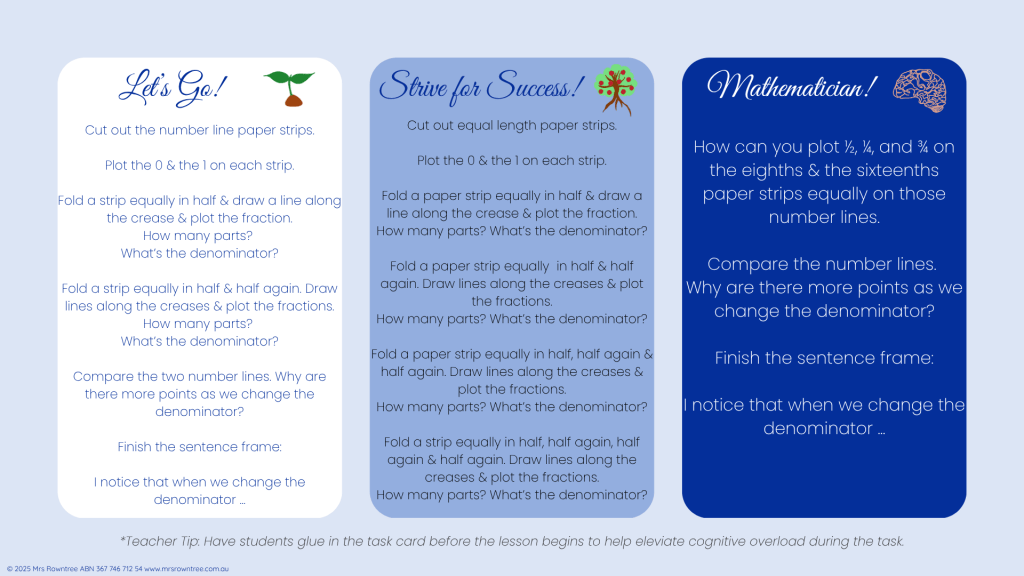
    I encourage you to try one of my learning tasks with your students tomorrow. Each task can serve as a vehicle to learn, observe or assess. Tell students that “Let’s Go!” Is below the level or entry level to the task, “Strive for Success!” Is at the level and ideally they begin there before moving on to “Mathematician!”  Which is beyond the level or extension and just watch the result as students choose and are given the opportunity to develop their metacognition.

    Even the kids working at the low level will get to experience success and those feelings that encourage their efforts. This is encouraging, inspiring and keeps them going positively! How many times the kids working at the high levels who come to me later about their drive to solve it is just gold!

    You’ll see children striving to solve the “Mathematician!” level. You’ll witness children who are not confident entering in “Let’s Go!” level but overcome it and experience that joy & you’ll see exactly where each student is at by interpreting their individual way of reasoning as they address each challenge. Each of the vehicles of learning, observing and assessing is embedded and you’ll see aspects of each in your lesson unfold naturally. You can then choose which vehicle requires your attention and response.

    Each one of my lessons includes a task with “Let’s Go!”, “Strive for Success!” & “Mathematician!” and all of these can be interpreted as an assessment. I consider all my tasks as informal assessments that provide important information about each child’s needs to move forward and grow both mathematically and successfully with wellbeing intact.


    Give it a try tomorrow. You can download one of my Freebie maths lessons at my store on Teach Buy Sell https://teachbuysell.com.au/store/Mrs-Rowntree
    Let me know how it goes!

  • Juggling Curriculum, Responsive Teaching and Intervention

    It’s Week 10, and you glance at the untouched strand of the curriculum, you realise time is running out! At the conclusion of Term 3, the feedback from teachers was that they must move on with their maths curriculum content. They struggle with knowing that their students need responsive teaching and consolidation, but how to cover the extensive curriculum! So the verdict is a very worrisome one: I must move on, or risk not covering the content!

    The coverage of curriculum is a very common and typical dilemma and I too have grappled with this predicament. Teaching and curriculum design is very much like the layers of an onion, where the concepts are layered and as the onion is peeled back it reveals the depth, flexibility and broad scale of ideas. I know how hard it is to find relevant content quickly, especially for time-poor staff; I’ve been guilty of handing over a worksheet that somewhat aligns with the content, only to find that its just not suitable, progressive enough, or just far too difficult!

    I acknowledge from my experience from working across multiple sites and across various public and private sectors, there are many ways to deliver curriculum content for similar outcomes. Some strategies I’ve used in the past were using daily fluency lessons. I discovered through action research that fluency can improve place value outcomes for indigenous students. I used a very intentional design approach to reflect the big ideas and cyclic pedagogy.

    The trick is to integrate as much conceptual understanding, real world links and flexibility of thinking about broad concepts with simplicity. This takes me some thinking time! How do you plan to integrate content and layer conceptual ideas? And, how are you supporting students who still need more practise?

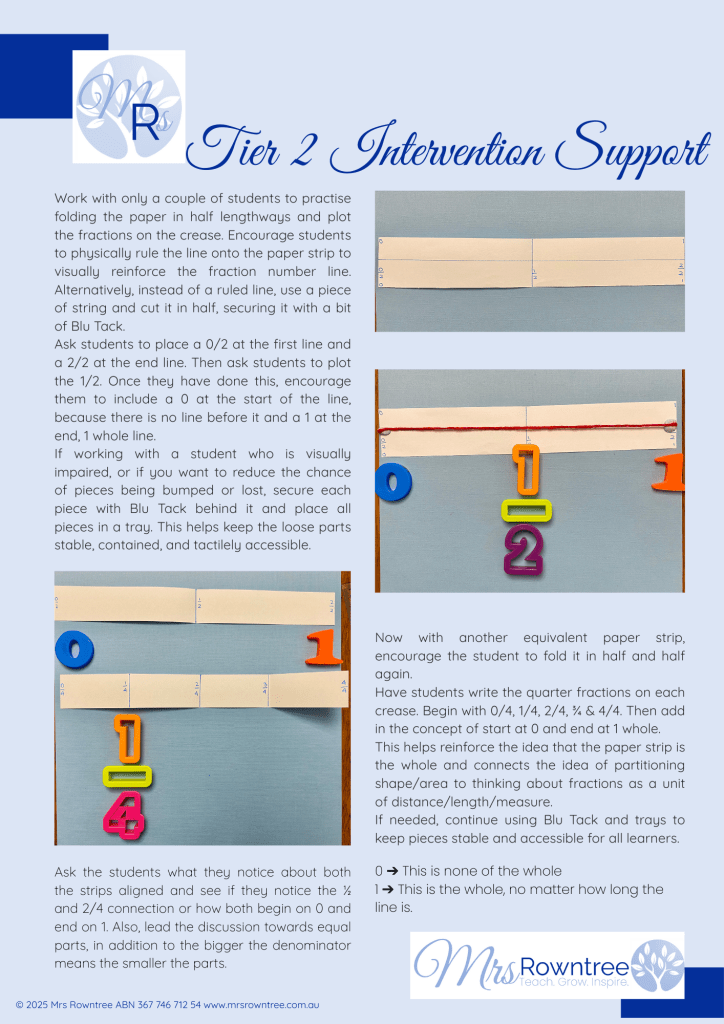
    While I continue my journey to write clear and concise plans with depth, there are some intervention ideas that accompany my lessons 1 to 4 of each unit plan, which might help you now. You might choose to use the Tier 2 Intervention Support for small group work or fluency introductions to cycle back over content before lessons. They are great one pagers that progressively guide the teacher to aid students requiring Tier 2 support.

    I’d love to hear from you. Follow me for more intervention content and comment with your own strategies.

    To save you time, I’ve included a ready-to-go Tier 2 Intervention page from my Freebie on Year 4 Fractions: Equal Distance. https://teachbuysell.com.au/l/1-freebie-year-4-fractions-equal-distance-lesson/68b7a216-a89c-4a9c-a508-1663fcc0a115

    Link to Mrs Rowntree’s Facebook Page: https://www.facebook.com/profile.php?id=61579326940167

  • The Art of Maths Design!

    Mathematics curriculum design is an art form! It is intentional, progressive and nuanced. It is designing a roadmap that saves teachers time, unlocks the big ideas and addresses misconceptions at the get go! As a teacher, you don’t always have time to piece together a clear progression and can easily end up presenting scattered lessons.  I know, because I’ve been there too! That’s why I design units that ensure clarity, progression, and depth. I’m talking about a fully thought out progressive plan that has a very clear endpoint, encompassing the big ideas of mathematics, the learning progression of students and the misconceptions that are commonly presented. 

    Without knowing where we are going, we won’t know where we have been or how successful we are. A clear endpoint makes the progression of learning intentions much easier to develop. An ability to assess students’ knowledge is also easier for everyone because we know what we want them to know. With the endpoint in mind, teachers & assistants can then make decisions about how broadly they want to explore a topic and how to get all of the students there. If a diversion occurs, that’s ok because we can quickly return to the learning path. And let’s be real honest here, when does a diversion NOT happen in Australian classrooms? 

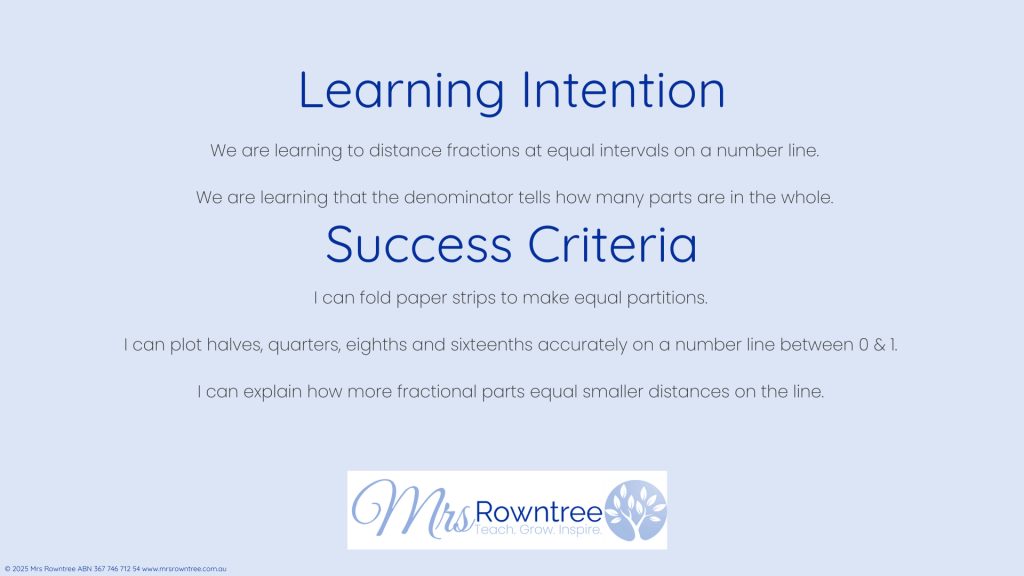
    In the classroom, learning intentions and success criteria keep each lesson on track towards those end goal posts. A learning intention is a transferable skill. It is not how to do something in a specific context; it is a skill that can be applied in multiple contexts. A skill that the children can take with them to solve other problems. 

    In one Year 4 lesson, a student placed fractions on the number line but missed the equal spacing idea. Another mixed up denominators, thinking a larger denominator meant a larger part. It wasn’t until we compared denominators together that the misconception clicked. That’s where clear learning intentions shifted everything.

    On the other hand, success criteria is the context in which students are learning the skill. So it tells kids what they need to be able to do to ensure they have learnt the skill in the context of the lesson. If you’d love a ready-to-use example, download my Free Fractions: Equal Distance lesson. You’ll see how I build learning intentions and success criteria into every unit—so you can spend less time planning and more time teaching. I even taught this lesson with some Year 3s very successfully today, because lesson 1 also applies to Year 3. Learning intentions and success criteria are so important for every lesson because it just keeps everyone working toward shared goals.

    Even bigger than learning intentions are the big ideas. These are those ideas of which researchers commonly continue to clarify. It’s those big overarching conceptual ideas that are transferable skills. These ideas should always connect to learning intentions in the maths realm. These ideas lift the learning to a new height and enable educators to set high expectations, striving for all and diverse student subsets to excel, explore concepts broadly and with depth. 

    To be able to access the big ideas, learning progressions require educators’ attention because these are the researched journeys required to be able to get to the learning intentions. They are not always straightforward, in that every student will necessarily follow that path, however they do give a really good idea as to what is likely to happen in child development across the ages. These help the progressive plan head towards the intended outcomes without too many mishaps.

    Mishaps do happen along the way, how many times do you interpret communication differently? We all have those different perspectives and what one person interprets the other hears something totally different! This is why teaching to minimise the opportunity for misconceptions to develop is part of the process. 

    Like you, I’ve had students say to me “Ï just don’t know why you didn’t tell me that, or why didn’t you say so!” This is not that the teacher didn’t try to teach them, it sometimes just comes down to interpretation. Yet, even though this is normal and it happens, it doesn’t mean we shouldn’t address it straight away. We don’t want students to develop bad habits from misconceptions, or misunderstandings, or they lack an important foundation for further learning in mathematics. 

    Clarity is power for teachers and so is a carefully curated unit plan that includes big ideas, learning progressions and addressing misconceptions immediately. Ready-to-go lesson plans mean every teacher and assistant knows the goalposts. This is what I do at Mrs Rowntree. Teach. Grow. Inspire. I create carefully created unit plans that intentionally teach mathematics clearly and systematically, taking the planning time out of it. 

    How do you plan your maths units? I’d love to hear your experiences. Share your thoughts below — and if you’d like to see how I do it, grab my Free Fractions: Equal Distance lesson.

    Download a free lesson at https://teachbuysell.com.au/store/Mrs-Rowntree follow me at www.mrsrowntree.com.au or Facebook https://www.facebook.com/profile.php?id=61579326940167 or simply subscribe to my blog where I write about maths education in the primary years at www.mrsrowntree.com 

  • To Reason or Not to Reason

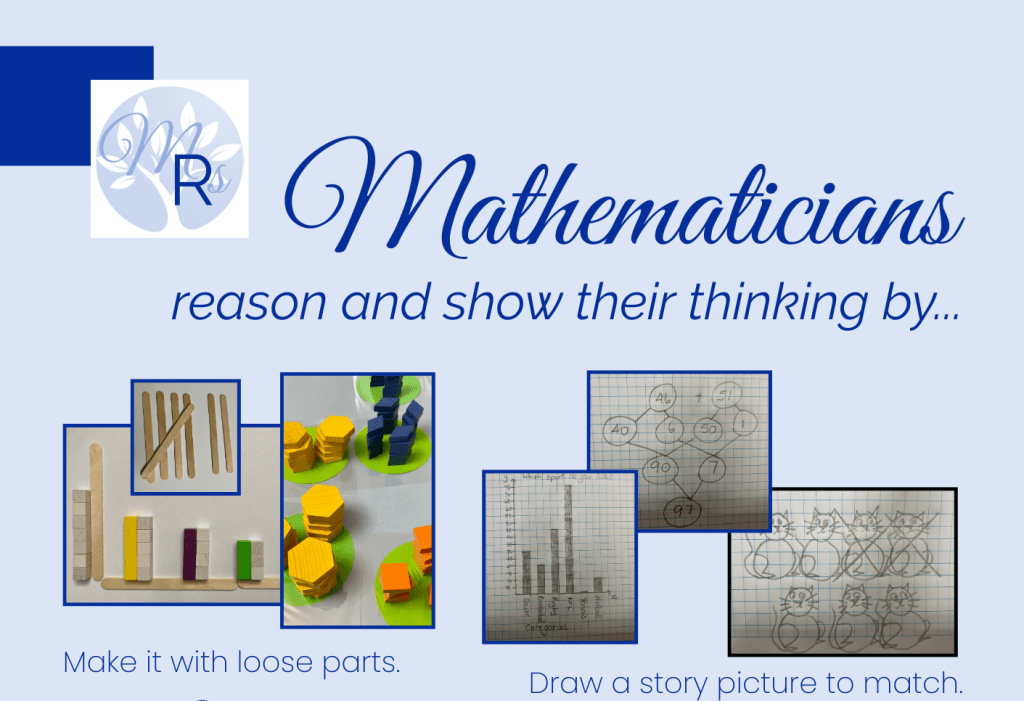
    You’ve all heard it: “I don’t know how I got the answer, I just know”! You know the moment – that moment when a student is adamant they just know, but they can’t explain their thinking. I’ve had this many times, so I began producing anchor charts with children to be really explicit about what my expectations were when I asked them to show their reasoning. 

    At the beginning of a year, I’ll run through some of the options of strategies to reason one at a time and give students time to practise each strategy. I’ll develop a three level task that enables them to develop their ability to demonstrate the reasoning strategies at different levels. Starting with the most basic way to use the strategy at ‘Let’s Go!’ level (a basic entry point to practise the strategy),  to develop it more at ‘Strive for Success!’ (developing it further with more challenge and at the level) and then to embed some kind of systematic thinking or justification into using that particular strategy at the ‘Mathematician!’ level (applying systematic thinking or justification beyond the level). This way, children can trial each strategy at a level that feels right for them, while the focus stays on reasoning. Revision tasks often become the vehicle for practising these strategies.

    Once many reasoning strategies have been trialled, children will develop their favourites so I ask them to choose their desired way to reason. I’ll often ask them to show me in two or three ways. This provides kids with some autonomy and control over their learning choices and I find they engage well with more choices. It also provides a window into their thinking so that teachers can see how children are approaching problems. Students are also forced to use metacognitive strategies, or their thinking about thinking, to justify their choices.

    Reasoning isn’t a natural skill, it takes time to practise and to develop. In fact, I’ve found it awesome to see what kids know and helps me with informative assessment and responsive teaching for the following day. I can then tell what the general understanding is of the room and plan appropriately. I’ve also found that the students learn from each other’s reasoning strategies during reflection times at the end of each lesson.

    Some of the kids in my fractions lesson yesterday, were drawing models, some were making equal groups of counters on Brenax circles and using coloured counters to represent the focus fraction of the predetermined collection quantity and others used sentences to explain their thinking. They all shared their reasoning at reflection times and it was great to see the diverse methods used.

    How will you develop your classroom expectations on reasoning? If you’d like a head start, sign up to my email list on my website at www.mrsrowntree.com.au and you will receive a free A3 printable reasoning anchor chart.

    Happy reasoning!!

    I’d love to hear how you encourage your students to reason, add your ideas into the comments below.

  • Intervention Made Easy!

    You’ve taught a great lesson, but some of your students still require more practise. You want to organise some maths intervention tasks, yet you have to meet with that parent tonight, organise an assembly piece, or organise a Father’s Day gift. Sound familiar?

    To have something ready-to-go that doesn’t require much prep or communication is ideal to help your students. That’s why I include the Tier 2 Intervention Tool in Mrs Rowntree’s resources, to give you a go-to-tool that you can use straight away. Whether you are using it with a small group of kids, 1-to-1, or whether another educator can work with students and know how to address common misconceptions is just gold. The intervention tools are aimed at developing foundational conceptual understandings required for each transferable skill.

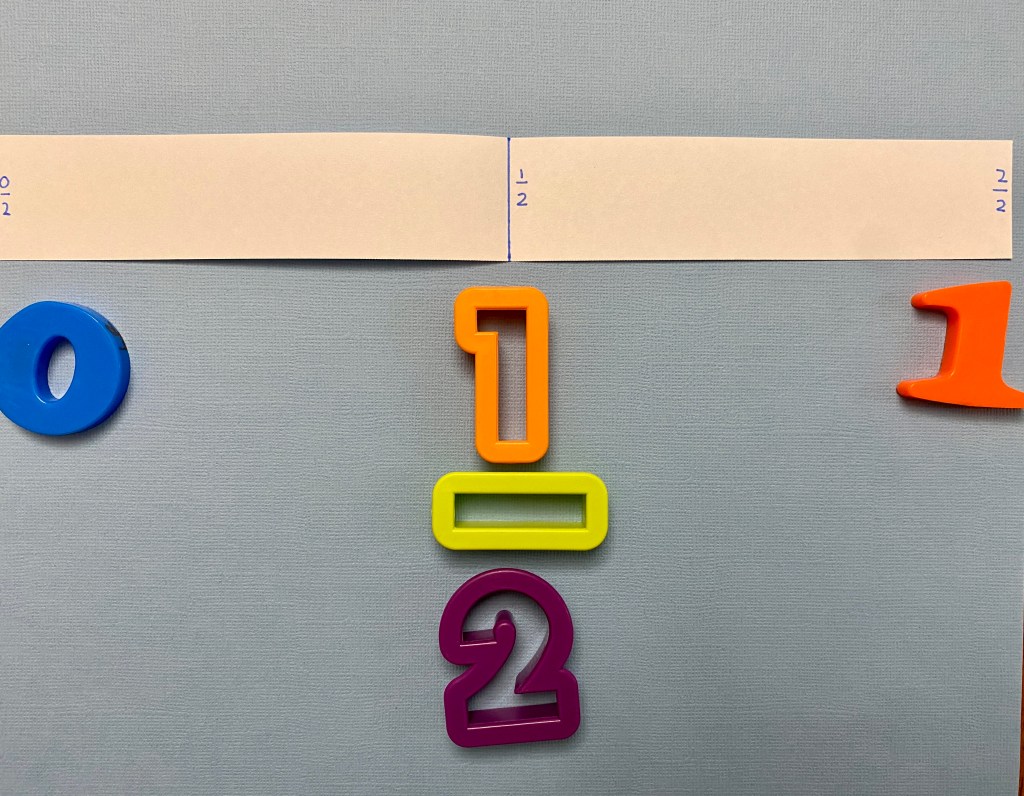
    An adaptable resource which is responsive to your students helps you make informed decisions flexibly. There are lots of ways to use this resource tool, including pre-teaching the maths ideas, working with a small group during the task, an educator working with a student after the task. You might choose to use the tool to help with goal setting for a student: I can portion halves equally on a number line, or I can plot 0 and 1 on a number line, or I can recognise that 0/2 is the same as zero parts, I can recognise that 2/2 = 1 whole…

    With this tool teachers can take it and know how to teach the skill in a tactile, hands-on way to diverse learners. There is also an included progression of learning to aid stretch and review at the child’s pace. If a student is visually impaired the tactile use is helpful, however tactile activities are wonderful for many students! I always offer manipulatives for kids to learn with. Even when I’m working in the older primary years (Year 5 & 6). I find manipulatives helpful and make them easily accessible on each table.

    When we don’t have time to develop mathematical skills, the children’s foundational conceptual understanding fails. This is detrimental to their maths progression! No wonder so many children find maths difficult later on; it’s because some of those important foundational skills have been missed along the way. When they are missed, that progress from visual to representative to symbolic is amiss.

    Below is a copy of the Year 4 Lesson 1 Fractions Distance Freebie, Tier 2 Intervention Tool. No need to have anything fancy, all you need is some paper, a pencil, string, Blu Tack, some numbers if you like and a student. Take it away and give it a go tomorrow. Go to https://teachbuysell.com.au/store/Mrs-Rowntree for the resource or find out more at www.mrsrowntree.com.au.

    Let me know how you go and leave a comment. What works for you for your maths intervention?

  • No Time!

    You’ve gone through the lesson content and the kids just don’t get it! You’re thinking ‘I need to keep going on this topic, but I can’t because there is just no time, and too much to cram in!’ I’ve had this many times when teaching kids, but I often come back to the thinking that if they don’t get it, and I move on, what good does that do for their learning growth? At least, when we have a purposeful, differentiated & cyclic plan for teaching maths we can ensure children get the best shot forward.

    Time is one of the big reasons why I decided to create 5 lesson maths units to help teachers. I wanted to create purposeful, sequenced curriculum content that provides depth, but I was challenged with the time element. I know you struggle with time, so to address this, each of my units consist of 5 intentionally sequenced lessons. The first is always free, the last is always an assessment. That way you have a ready-to-go differentiated unit that can be taught in a week. 

    If you need to spend another week on your content because your kids require more practice, my units are an option for you. If you require a differentiated lesson that is aimed at 3 levels, working below, working at & working beyond then my lessons may be of interest to you.  If you require some intervention ideas to support some of your learners then you will enjoy the Tier 2 Intervention Tool that is included with the first four lessons of each unit.

    Because I prefer quality over quantity, each unit takes time to create, but is truly worth your time. I pour a huge amount of nuanced thinking into each one to ensure broad conceptual development occurs at a rate that supports success and is achievable for students. 

    I value explicit strategy teaching and learning, reflection and movement from concrete to relational, to abstract thinking, whilst linking in to real world concepts. I totally value problem solving and I like to build children’s toolbox of strategies, so that they have success with the task. All this takes time!

    When do you get the time to truly pour into developing your maths curriculum content? If your children don’t gain the understanding, isn’t a week of polished, purposeful & cyclic learning more powerful than rushing through the curriculum. 

     What do you do to ensure your students ‘get it’?


    If you’ve taught fractions this term and you need some extra time on it, jump on over to https://teachbuysell.com.au/store/Mrs-Rowntree to download a unit or lesson. Alternatively, sign up for email notifications at www.mrsrowntree.com.au and be the first to hear of newly released units.

    I hope this helps you a fraction! Halves your work and brings you a quarter of joy!

    Have a great day!