Mrs Rowntree

Teach. Grow. Inspire.

  • To Reason or Not to Reason

    You’ve all heard it: “I don’t know how I got the answer, I just know”! You know the moment – that moment when a student is adamant they just know, but they can’t explain their thinking. I’ve had this many times, so I began producing anchor charts with children to be really explicit about what my expectations were when I asked them to show their reasoning. 

    At the beginning of a year, I’ll run through some of the options of strategies to reason one at a time and give students time to practise each strategy. I’ll develop a three level task that enables them to develop their ability to demonstrate the reasoning strategies at different levels. Starting with the most basic way to use the strategy at ‘Let’s Go!’ level (a basic entry point to practise the strategy),  to develop it more at ‘Strive for Success!’ (developing it further with more challenge and at the level) and then to embed some kind of systematic thinking or justification into using that particular strategy at the ‘Mathematician!’ level (applying systematic thinking or justification beyond the level). This way, children can trial each strategy at a level that feels right for them, while the focus stays on reasoning. Revision tasks often become the vehicle for practising these strategies.

    Once many reasoning strategies have been trialled, children will develop their favourites so I ask them to choose their desired way to reason. I’ll often ask them to show me in two or three ways. This provides kids with some autonomy and control over their learning choices and I find they engage well with more choices. It also provides a window into their thinking so that teachers can see how children are approaching problems. Students are also forced to use metacognitive strategies, or their thinking about thinking, to justify their choices.

    Reasoning isn’t a natural skill, it takes time to practise and to develop. In fact, I’ve found it awesome to see what kids know and helps me with informative assessment and responsive teaching for the following day. I can then tell what the general understanding is of the room and plan appropriately. I’ve also found that the students learn from each other’s reasoning strategies during reflection times at the end of each lesson.

    Some of the kids in my fractions lesson yesterday, were drawing models, some were making equal groups of counters on Brenax circles and using coloured counters to represent the focus fraction of the predetermined collection quantity and others used sentences to explain their thinking. They all shared their reasoning at reflection times and it was great to see the diverse methods used.

    How will you develop your classroom expectations on reasoning? If you’d like a head start, sign up to my email list on my website at www.mrsrowntree.com.au and you will receive a free A3 printable reasoning anchor chart.

    Happy reasoning!!

    I’d love to hear how you encourage your students to reason, add your ideas into the comments below.

  • Intervention Made Easy!

    You’ve taught a great lesson, but some of your students still require more practise. You want to organise some maths intervention tasks, yet you have to meet with that parent tonight, organise an assembly piece, or organise a Father’s Day gift. Sound familiar?

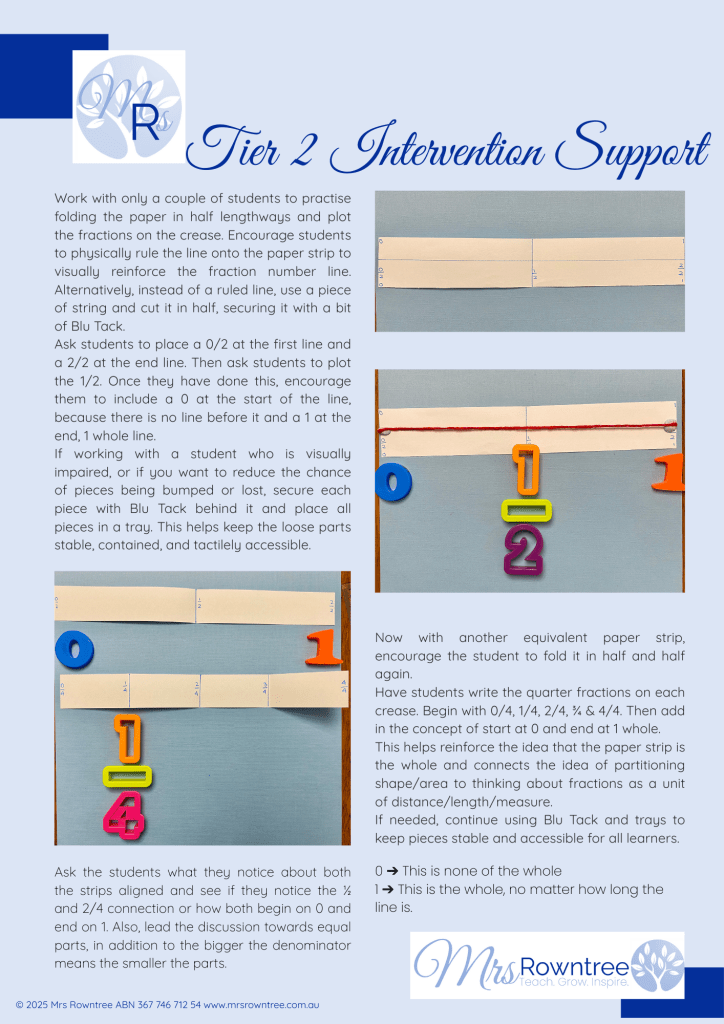
    To have something ready-to-go that doesn’t require much prep or communication is ideal to help your students. That’s why I include the Tier 2 Intervention Tool in Mrs Rowntree’s resources, to give you a go-to-tool that you can use straight away. Whether you are using it with a small group of kids, 1-to-1, or whether another educator can work with students and know how to address common misconceptions is just gold. The intervention tools are aimed at developing foundational conceptual understandings required for each transferable skill.

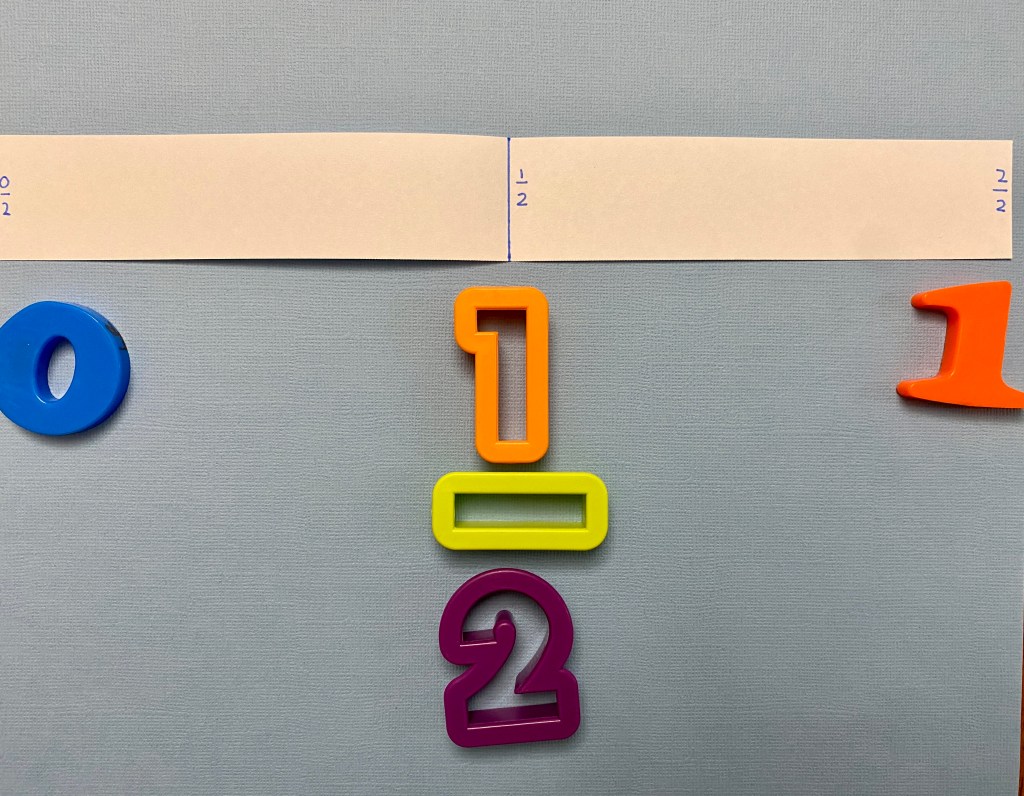
    An adaptable resource which is responsive to your students helps you make informed decisions flexibly. There are lots of ways to use this resource tool, including pre-teaching the maths ideas, working with a small group during the task, an educator working with a student after the task. You might choose to use the tool to help with goal setting for a student: I can portion halves equally on a number line, or I can plot 0 and 1 on a number line, or I can recognise that 0/2 is the same as zero parts, I can recognise that 2/2 = 1 whole…

    With this tool teachers can take it and know how to teach the skill in a tactile, hands-on way to diverse learners. There is also an included progression of learning to aid stretch and review at the child’s pace. If a student is visually impaired the tactile use is helpful, however tactile activities are wonderful for many students! I always offer manipulatives for kids to learn with. Even when I’m working in the older primary years (Year 5 & 6). I find manipulatives helpful and make them easily accessible on each table.

    When we don’t have time to develop mathematical skills, the children’s foundational conceptual understanding fails. This is detrimental to their maths progression! No wonder so many children find maths difficult later on; it’s because some of those important foundational skills have been missed along the way. When they are missed, that progress from visual to representative to symbolic is amiss.

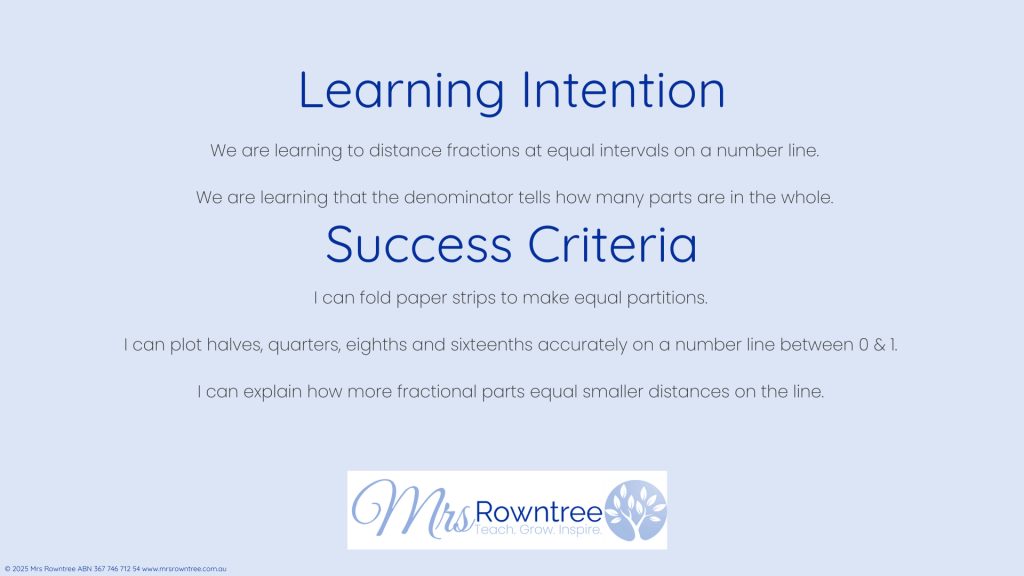
    Below is a copy of the Year 4 Lesson 1 Fractions Distance Freebie, Tier 2 Intervention Tool. No need to have anything fancy, all you need is some paper, a pencil, string, Blu Tack, some numbers if you like and a student. Take it away and give it a go tomorrow. Go to https://teachbuysell.com.au/store/Mrs-Rowntree for the resource or find out more at www.mrsrowntree.com.au.

    Let me know how you go and leave a comment. What works for you for your maths intervention?

  • No Time!

    You’ve gone through the lesson content and the kids just don’t get it! You’re thinking ‘I need to keep going on this topic, but I can’t because there is just no time, and too much to cram in!’ I’ve had this many times when teaching kids, but I often come back to the thinking that if they don’t get it, and I move on, what good does that do for their learning growth? At least, when we have a purposeful, differentiated & cyclic plan for teaching maths we can ensure children get the best shot forward.

    Time is one of the big reasons why I decided to create 5 lesson maths units to help teachers. I wanted to create purposeful, sequenced curriculum content that provides depth, but I was challenged with the time element. I know you struggle with time, so to address this, each of my units consist of 5 intentionally sequenced lessons. The first is always free, the last is always an assessment. That way you have a ready-to-go differentiated unit that can be taught in a week. 

    If you need to spend another week on your content because your kids require more practice, my units are an option for you. If you require a differentiated lesson that is aimed at 3 levels, working below, working at & working beyond then my lessons may be of interest to you.  If you require some intervention ideas to support some of your learners then you will enjoy the Tier 2 Intervention Tool that is included with the first four lessons of each unit.

    Because I prefer quality over quantity, each unit takes time to create, but is truly worth your time. I pour a huge amount of nuanced thinking into each one to ensure broad conceptual development occurs at a rate that supports success and is achievable for students. 

    I value explicit strategy teaching and learning, reflection and movement from concrete to relational, to abstract thinking, whilst linking in to real world concepts. I totally value problem solving and I like to build children’s toolbox of strategies, so that they have success with the task. All this takes time!

    When do you get the time to truly pour into developing your maths curriculum content? If your children don’t gain the understanding, isn’t a week of polished, purposeful & cyclic learning more powerful than rushing through the curriculum. 

     What do you do to ensure your students ‘get it’?


    If you’ve taught fractions this term and you need some extra time on it, jump on over to https://teachbuysell.com.au/store/Mrs-Rowntree to download a unit or lesson. Alternatively, sign up for email notifications at www.mrsrowntree.com.au and be the first to hear of newly released units.

    I hope this helps you a fraction! Halves your work and brings you a quarter of joy!

    Have a great day!

  • Thinking About Thinking!

    The harder I can encourage children to think about their thinking, the less I feel I have to work! When I encourage children to reflect upon their learning, I find they begin to set themselves more appropriate goals and learn more. When students are setting themselves appropriate and achievable goals, then they are drivers of their own learning and growth. I believe this encouragement leads most kids to want to engage with the math content more.

    At the end of every lesson, I host a reflection discussion. Some kids are great at reflecting, and others can be way off the mark when it comes to self-assessment. Taking just a few minutes to talk about why they score their success at this or that is really key to helping with gauging their self-improvement. I try to ask how they will improve or maintain their score and discuss those learning strategies to strive for success & what that looks like.

    When kids can self-assess well, they can make really good choices about where to go for help and what to do next and even know where to start with ‘Let’s Go!, ‘Strive For Success!’ & ‘Mathematician!’ The more children reflect on their own learning, set their own mini goals, and strive to improve, the more their learning will enter their home discussions and drive exploration.

    In Mrs. Rowntree’s resources you’ll find a reflection page in every lesson presentation, like the one displayed here. Not only will children be encouraged to reflect upon their learning in accordance with the lesson’s success criteria, but also other students are encouraged to share their ideas and exemplary work to learn from each other. Head over to TeachBuySell at https://teachbuysell.com.au/store/Mrs-Rowntree to download a free lesson to try it out with your class and read about the teacher tips.

    Stay tuned for my next unit! Year 4 Fractions as Numbers on a Number Line. It will be the first of four units on fractions for Year 4 students.

  • Let’s Go!

    It’s so difficult to cater to the huge difference in learning abilities that exist in each classroom. To plan for and develop all the differentiation and the tools required takes up so much teacher time, but it’s so important. This is so much of the reason why I set upon this little project to develop mathematics curriculum content for primary teachers; to help my fellow colleagues. ‘Let’s Go!’, ‘Strive For Success!’ & ‘Mathematician!’ are the names I’ve assigned to a 3 level differentiated learning task, provided in each maths lesson, to support diverse learners. Head to www.mrsrowntree.com.au to find the direct link to the resource on Teach Buy Sell. ‘Let’s Go!’

    ‘Let’s Go!’ is the entry point for kids who are not confident with the topic. This level is generally working below the level. ‘Let’s Go!’ allows students to get started on the transferable skill after the explicit teaching introduction. When I talk about the levels with children who begin at ‘Let’s Go!’, they so often strive to get to the next level to complete it. Mind you, they require the time from teachers to work through the levels. ‘Strive for Success!’

    ‘Strive for Success!’ means working at the level standard and if students don’t start at ‘Let’s Go!’ the rest of the students start at ‘Strive for Success!’, generally. The only time I let students begin at ‘Mathematician!’ is if I am confident they will find the ‘Strive for Success!’ level really simplistic and I know they are very capable. This is rare! 

    ‘Mathematician!’ is the Holy Grail! It is the celebrated level that when achieved successfully, one can’t feel anything but complete triumph! I have many students who come to me at that level and say, ‘Mrs Rowntree, I need your help’ and often I am working on the floor with the ‘Let’s Go’ group so I just have to respond sometimes with ‘What an achievement that you got there, it’s designed to be tricky, so now you are going to need to work through it with your peers’. You should see the achievement, once they start to experience success with figuring it out. Or, the joy it brings me when they come back the next day and they have drawn mum or dad into the learning process to divide and completely conquer the task!

    For all levels, I always encourage kids to work together to collaborate and explore their ideas when working on maths tasks. This can make for a noisy classroom at times, particularly with the loose parts on each table, or on the floor, and the discussions going on, however there is often much rich learning taking place in this environment. It is no longer an option to work collaboratively, but a necessity, to support developing social skills, social awareness & maths. The collaboration, experimentation, reasoning & justification all adds up to an active but rich learning space, where mistakes are ok, kids learn from each other and we end up with many opportunities to learn from, broaden our thinking and grow.  

    These are not the only ways you can work with these levels, but please try it and enjoy the process. I’ll talk about the other ways another day

    ***To access the first lesson as a free download to try, please head to www.mrsrowntree.com.au and you’ll find the link to download it via Teach Buy Sell, under the Resources tab.