In many classrooms, mathematics quickly becomes all about getting the right answer. How often do students come to you to simply ask “Did I get it right?” If yes, they are ecstatic, if no they can often give up on the spot!
But what if we thought about the process: before students can confidently apply formulas or follow procedures, they need to understand the “why” the maths works the way it does.
That understanding doesn’t come from following a formula or from worksheets alone—it comes from experience.
We Build Understanding Before We Build Efficiency
I’ve been spending a lot of time in Foundation Year classrooms lately and I know that before a student can recognise that a group shows “6”, they need to count it.
More than once!
They need to move it, rearrange it, and see it from different perspectives and in different forms.
Over time, this learning becomes automatic—and in the teacher world, we call it subitising—but it all begins with repeated, hands-on exposure. And it’s the same for older year levels too.
This is what I mean by building trust in the maths.
➔Trust that the equation means that both sides are equal
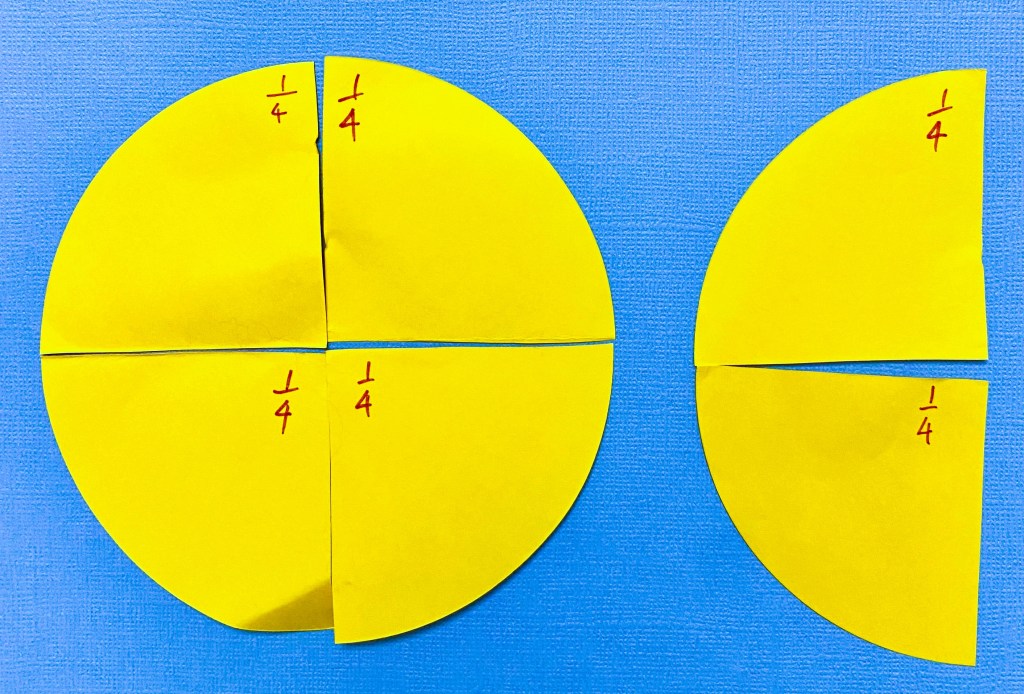
➔Trust that equal parts really are equal
➔Trust that the equation is true, even when it looks different
➔ Trust that the formulas work
Without that trust, formulas feel like rules to remember—not tools to understand.
Yes, It Can Be Messy… But It Matters
Hands-on maths isn’t always neat and easy —and honestly, most days it isn’t .
It looks like:
- It looks like cut-up paper everywhere, bits on the floor, and students halfway through rebuilding something they just pulled apart.
- Students moving pieces around
- Materials being shared, dropped, and rebuilt
- Conversations between peers about maths on the side
- Somewhat a little louder and a little busier classrooms
- The teacher working with a group of students
And yes—it often takes more time.
But this kind of learning is doing something very important:
- Strengthening memory through movement
- Connecting ideas through visual and tactile experiences
- Building curiosity and engagement
Students aren’t just seeing the maths—they’re experiencing it.
But What About Traditional Methods?
Shading diagrams, drawing models, and completing structured worksheets all have their place.
➔ They are efficient.
➔ They are familiar.
➔They are easier to manage.
But the question is:
➔ Do they work for every learner?
For many students, these methods often come after understanding—not before it.
Without the hands-on foundation, some students learn to follow steps without ever truly understanding what they’re doing and why.
From Hands-On to Abstract: The Missing Link
The goal isn’t to stay in the concrete stage forever.
It’s to move through a clear progression:
- Concrete – students build and manipulate
- Visual – students represent what they see
- Abstract – students use numbers and symbols
When this progression is intentional, students don’t just memorise—they understand.
And when they understand, they’re far more likely to:
- Retain what they’ve learned
- Generalising their learning and applying it in new situations
- Feel confident in their thinking and confident in their exploration
Where This Fits in My Fraction Lessons
This thinking sits at the centre of how I design my lessons.
In my fractions unit, students don’t always start with numbers on a page.
They begin by:
- Physically partitioning wholes
- Exploring equal parts
- Building number lines through hands-on tasks
Only then do we move toward representing fractions numerically.
➔ Because the goal isn’t just to do fractions
➔ It’s to understand fractions
Hands-on maths takes time.
It can feel slower.
And yes—it can be messy.
But it builds something that worksheets alone often can’t:
➔ Confidence
➔ Depth of understanding
➔Trust in the mathematics
And that’s what makes everything that comes after—formulas, procedures, and problem-solving—actually stick.
The lesson that inspired my blog today can be found on my site at TeachBuySell https://teachbuysell.com.au/l/free-fractions-as-collections-non-unit-thirds-year-4-lesson-ready-to-teach-differentiated/68e257bd-fef6-4b52-ac75-cf0c1dbbb0bd
And what’s even better is that this lesson is FREE

