Do you ever feel like you are doing all of the right things when teaching doubles, but you’re not seeing transfer?
A student can know their doubles facts and still not use doubling as a mathematical strategy.
But what does it actually mean to know doubles?
- Is it getting 10/10 for facts?
- Is it answering quickly?
- Recall over consecutive days?
- Applying doubles to near doubles?
- Recognising patterns?
- Is it using doubles as a tool to solve other problems?
- Is it that students showed it worked once, so that proves the rule works every time?
- Explaining why doubling works?
Because these are not necessarily the same thing. A score can tell us whether students can recall a fact. It doesn’t necessarily tell us whether they’ve built a usable strategy.
We know as teachers we have to teach doubles. It’s in the curriculum, they’re important for developing fluency, and we want students to be increasingly efficient with them.
I don’t want my students to simply memorise doubles and move on.
We’ve got the students who rattle off doubles facts instantly, but can’t relate doubles as a strategy to figure out near doubles.
We’ve got the student who needs to count all from one, students who know doubles but don’t see the link to doubling odd & even numbers to get even numbers.
Students who know some of the doubles facts but not double 7, 8 & 9.
Students who require visual supports and others who appear not to.
Then we have the students who recognise that 4 + 4 represents two equal groups of 4. Can they connect this to 2 × 4?
How do we guide them towards that all-important mathematical jump to multiplicative thinking, where they make the conceptual connection, rather than us immediately making the connection for them — and then wondering why they don’t remember it?
So goodness knows how teachers cater for all those needs at once! How on earth are teachers supposed to differentiate all of that simultaneously?
Make the differentiation invisible.
But of course, teachers don’t want more work to differentiate, like, six different worksheets for six different students! No way!
Rather, we want the mathematics to stay the same while the sophistication of the thinking changes.
I want your students to understand why doubling behaves the way it does. I want your students to notice particular patterns when doubling.
This is why I built my Doubles Fluency Program.
I didn’t want students simply to practise doubles until they could recall them.
I wanted them to build doubles into their mathematical toolbox — something they could retrieve, represent, reason with and eventually use to solve something they hadn’t been explicitly taught.
Because the goal isn’t simply:
“Do you know your doubles?”
It’s:
“What can you do with what you know?”
The constraints I impose allow your students to truly zoom in to investigate the numbers in context, and draw out those explicit lessons, otherwise missed if we looked too broadly.
Here are some ideas about how to use my Doubles Fluency Program:
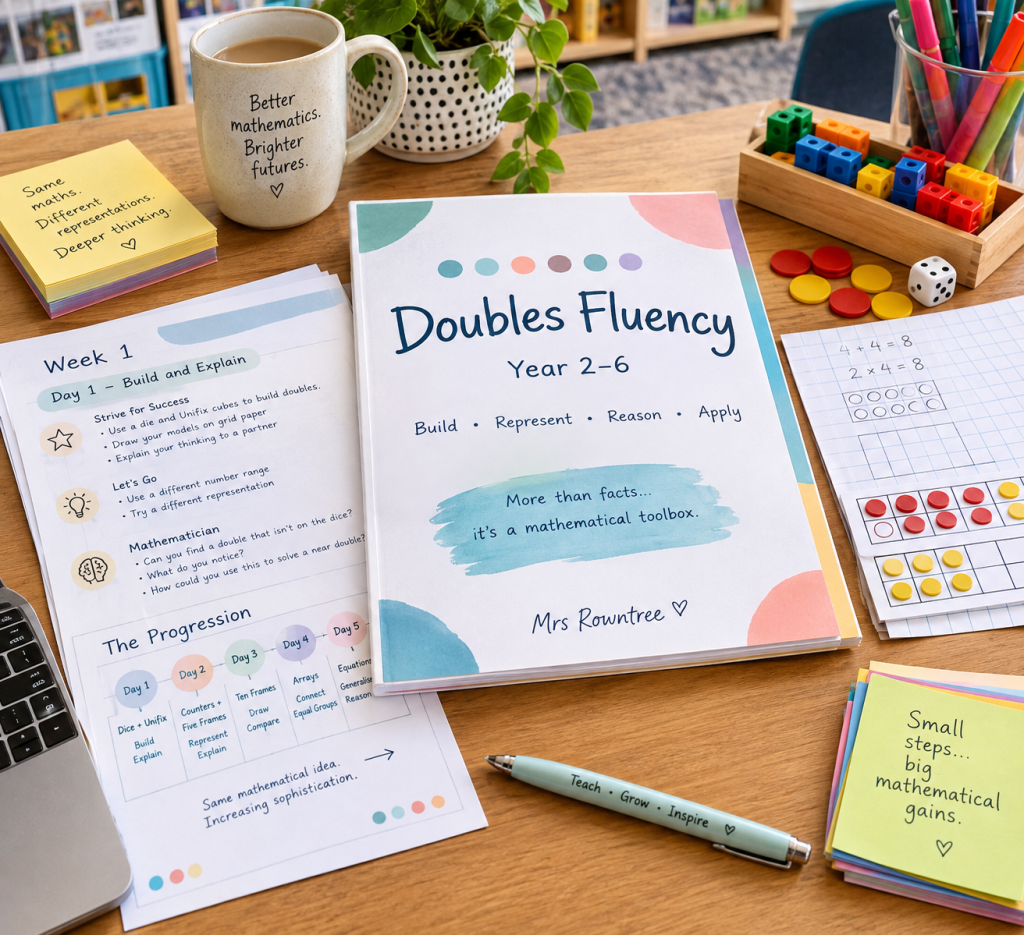
Day 1: dice + Unifix cubes → model → explain
Day 2: counters + five frames → represent → explain
Day 3: ten frames → draw → compare
Day 4: array representation → connect equal groups
Day 5: equations/reasoning → articulate the mathematical relationship
Each fluency routine lasting a maximum of 10 minutes.
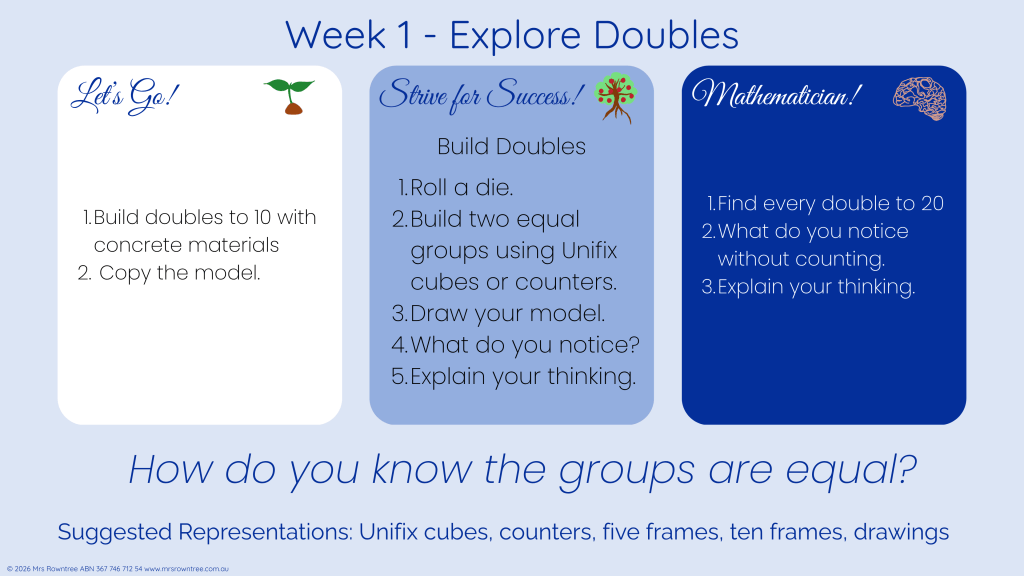
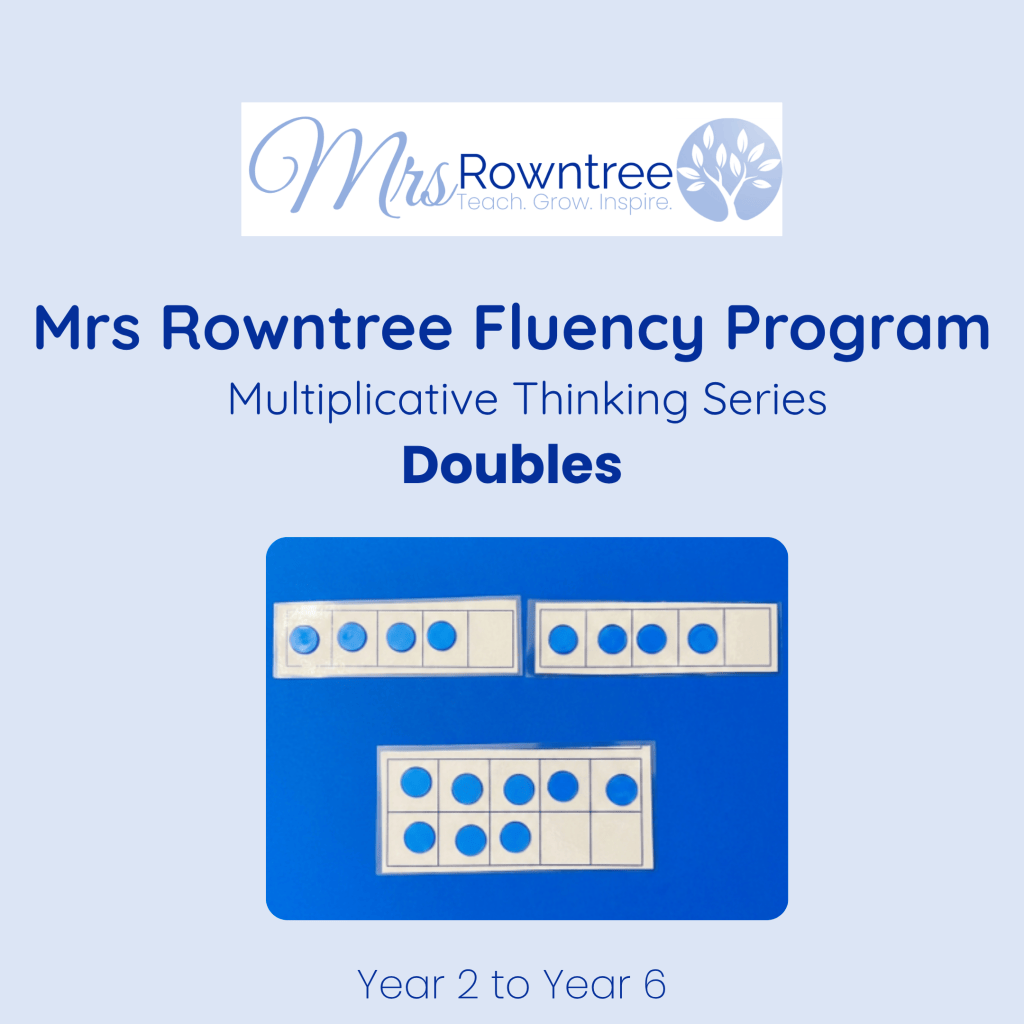
Here is a snippet of my Year 2-6 Doubles Fluency Program, or you can purchase and download the whole program and begin using it tomorrow.
Written with love, because I care about you and your students!
Explore my other resources:
Teachers Pay Teachers — Mrs Rowntree Primary Maths