Mathematics curriculum design is an art form! It is intentional, progressive and nuanced. It is designing a roadmap that saves teachers time, unlocks the big ideas and addresses misconceptions at the get go! As a teacher, you don’t always have time to piece together a clear progression and can easily end up presenting scattered lessons. I know, because I’ve been there too! That’s why I design units that ensure clarity, progression, and depth. I’m talking about a fully thought out progressive plan that has a very clear endpoint, encompassing the big ideas of mathematics, the learning progression of students and the misconceptions that are commonly presented.
Without knowing where we are going, we won’t know where we have been or how successful we are. A clear endpoint makes the progression of learning intentions much easier to develop. An ability to assess students’ knowledge is also easier for everyone because we know what we want them to know. With the endpoint in mind, teachers & assistants can then make decisions about how broadly they want to explore a topic and how to get all of the students there. If a diversion occurs, that’s ok because we can quickly return to the learning path. And let’s be real honest here, when does a diversion NOT happen in Australian classrooms?
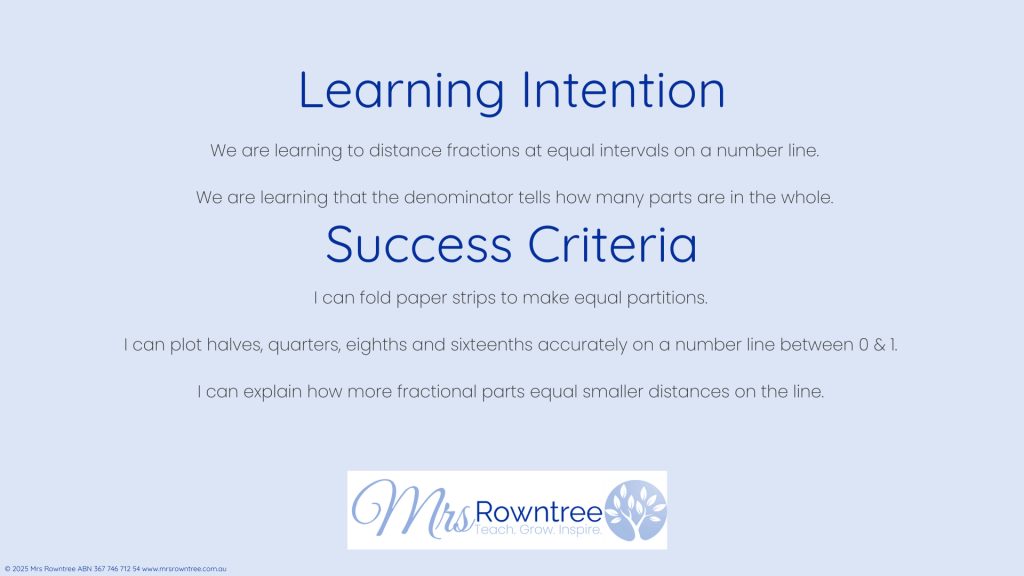
In the classroom, learning intentions and success criteria keep each lesson on track towards those end goal posts. A learning intention is a transferable skill. It is not how to do something in a specific context; it is a skill that can be applied in multiple contexts. A skill that the children can take with them to solve other problems.
In one Year 4 lesson, a student placed fractions on the number line but missed the equal spacing idea. Another mixed up denominators, thinking a larger denominator meant a larger part. It wasn’t until we compared denominators together that the misconception clicked. That’s where clear learning intentions shifted everything.
On the other hand, success criteria is the context in which students are learning the skill. So it tells kids what they need to be able to do to ensure they have learnt the skill in the context of the lesson. If you’d love a ready-to-use example, download my Free Fractions: Equal Distance lesson. You’ll see how I build learning intentions and success criteria into every unit—so you can spend less time planning and more time teaching. I even taught this lesson with some Year 3s very successfully today, because lesson 1 also applies to Year 3. Learning intentions and success criteria are so important for every lesson because it just keeps everyone working toward shared goals.
Even bigger than learning intentions are the big ideas. These are those ideas of which researchers commonly continue to clarify. It’s those big overarching conceptual ideas that are transferable skills. These ideas should always connect to learning intentions in the maths realm. These ideas lift the learning to a new height and enable educators to set high expectations, striving for all and diverse student subsets to excel, explore concepts broadly and with depth.
To be able to access the big ideas, learning progressions require educators’ attention because these are the researched journeys required to be able to get to the learning intentions. They are not always straightforward, in that every student will necessarily follow that path, however they do give a really good idea as to what is likely to happen in child development across the ages. These help the progressive plan head towards the intended outcomes without too many mishaps.
Mishaps do happen along the way, how many times do you interpret communication differently? We all have those different perspectives and what one person interprets the other hears something totally different! This is why teaching to minimise the opportunity for misconceptions to develop is part of the process.
Like you, I’ve had students say to me “Ï just don’t know why you didn’t tell me that, or why didn’t you say so!” This is not that the teacher didn’t try to teach them, it sometimes just comes down to interpretation. Yet, even though this is normal and it happens, it doesn’t mean we shouldn’t address it straight away. We don’t want students to develop bad habits from misconceptions, or misunderstandings, or they lack an important foundation for further learning in mathematics.
Clarity is power for teachers and so is a carefully curated unit plan that includes big ideas, learning progressions and addressing misconceptions immediately. Ready-to-go lesson plans mean every teacher and assistant knows the goalposts. This is what I do at Mrs Rowntree. Teach. Grow. Inspire. I create carefully created unit plans that intentionally teach mathematics clearly and systematically, taking the planning time out of it.
How do you plan your maths units? I’d love to hear your experiences. Share your thoughts below — and if you’d like to see how I do it, grab my Free Fractions: Equal Distance lesson.
Download a free lesson at https://teachbuysell.com.au/store/Mrs-Rowntree follow me at www.mrsrowntree.com.au or Facebook https://www.facebook.com/profile.php?id=61579326940167 or simply subscribe to my blog where I write about maths education in the primary years at www.mrsrowntree.com

 Mrs Rowntree