Feeling buried under assessment lately? Between endless marking, data entry, and generating purposeful feedback, it’s easy to lose sight of what is really needle moving for students’ learning. Over the years, I’ve found ways to make assessment more meaningful and manageable, especially in maths lessons.
It’s so easy to feel overwhelmed by assessment! I’ve worked in continuous reporting systems and I’ve even made precious time in my lessons for students to review the feedback I gave, just so that my efforts haven’t gone into the never-never & so that my students can use the feedback to improve.
I used to think the only way to be thorough was to mark everything. I’d stay late, chasing the feeling that I was accountable and had to complete more marking. I thought this meant better teaching because I had all this data, but the truth is, it often meant more burnout and less impact!
A lot of the time, students are still strengthening their mathematical conceptual understanding. Much of the assessment we do through the year is still formative to guide the learning through to the end of the year. This is why I design open-ended maths tasks for students to work through. These are designed to strengthen conceptual skills and build flexibility in thinking broadly around the topics.
Each week, I go in with a clear student schedule. I plan for who I’ll work with, when I’ll work with them & how often. Not planning to just work with the students who need extra help, but those who need extending too. Each student is a little different and some require more scheduled times with me than others, but all students are worthy of regular teacher time. I keep a simple table with names, dates, and next steps. This helps me stay responsive without getting stuck with only the loudest or most demanding learners. I will often timetable maths lessons when I have some support so that I am free to work with students.
Now I hear you when you say, it gets tricky to schedule group work when there is not much in the way of support staff in your classroom. That’s when I train the kids in what to do when I’m working with others. You’ll have all those great strategies and routines that support working with small groups!
Having time to work with everyone, enables me to formatively assess in the lesson, not after! This kind of formative assessment in maths helps me decide what comes next, not just what to record. I’m not having to mark every piece and instead I can quickly glance over books at the end of the lesson. Couple this method with insisting upon a whole class reflection time after every lesson ensures I have a sound understanding of where my students are at and what’s necessary for tomorrow. These are the meaningful assessment methods I’ve found to save me bucketloads of time, as these two methods alleviate sitting at my desk marking away, providing feedback to a book or a computer that no-one ever looks at!
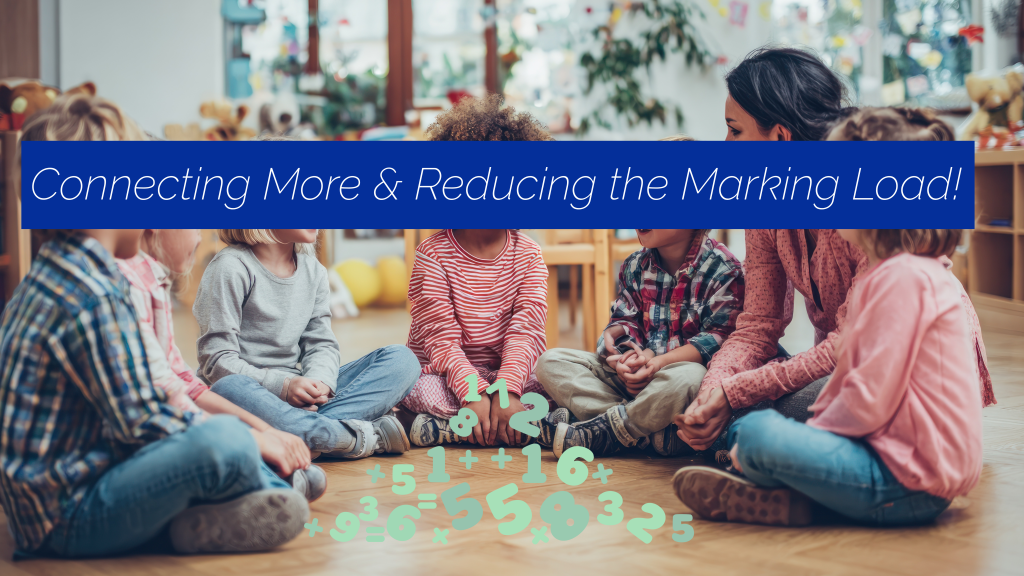
I don’t believe we need to mark more, I believe we need to connect more, observe more, listen more and teach responsively more!
Why not try it tomorrow?
Finish your lesson ten minutes early for reflection, or line up your maths block with a time allocated with a learning support person, so you can observe and collaborate more freely. Small shifts like these can make a big difference , not just for your marking load, but for your peace of mind too and your students learning.

Ps: If you’d like more, you can find my maths lessons here
 Mrs Rowntree