In a maths professional development one day, I remember the instructor discussing assessments and data with classroom teachers and I raised my hand to ask “What about student wellbeing?” My question was quickly shut down and dismissed. With much maths anxiety existing in our classrooms and the prevalence of maths anxiety being well researched, I find it really interesting that we continue to dismiss the ideas of over assessing skills in standardised ways.
Perhaps our quest for consistent assessment stems from the Australian Curriculum’s purpose to provide consistency across learning & assessment. But, do we really need to rigorously assess our primary school students in a standardised way all of the time?
Standardised testing is a method of testing where there is either a consistent right or a wrong answer. It doesn’t generally consider alternate ways of thinking and approaching tasks creatively and using varied strategies. The presentation is consistent, the marking is consistent and the interpretation must remain consistent to maintain “fairness”. However, consistently for all, is this really fair? How are our low & high learners supported & stretched?
I support open-ended assessment; If we teach the skills and strategies, then it is up to students to demonstrate how they can meet the outcomes, develop their skills or extend themselves. Teacher interpretation of student ability then becomes the skill of teachers’ to judge how they assess our students’ ways of thinking. Yes, this method is not as “consistent” as standardised assessment, but it is much kinder to our students, trusts teacher judgement and allows us to nurture our student wellbeing, encourage learning, growth, inspire student creativity & maths exploration.
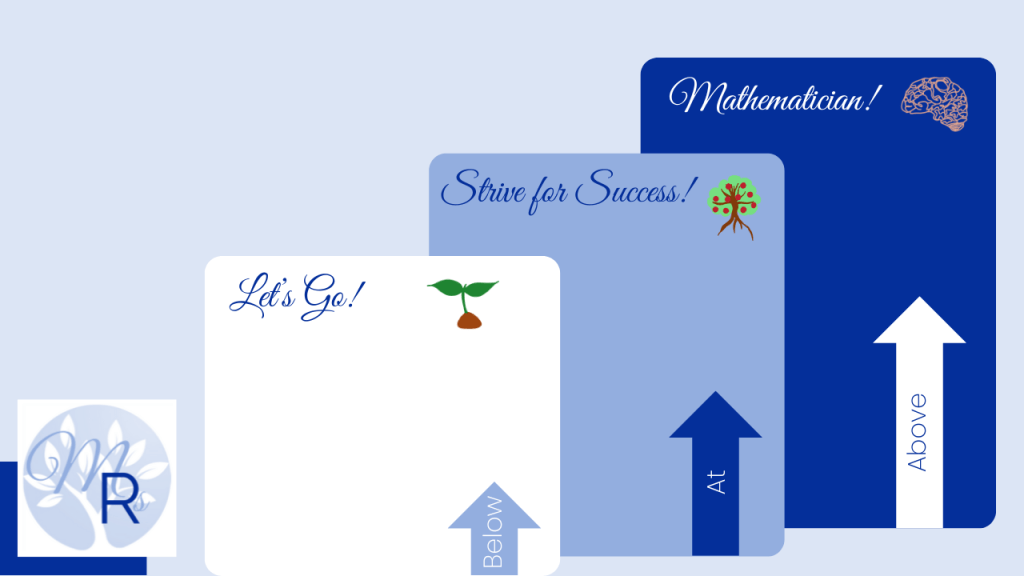
I encourage you to try one of my learning tasks with your students tomorrow. Each task can serve as a vehicle to learn, observe or assess. Tell students that “Let’s Go!” Is below the level or entry level to the task, “Strive for Success!” Is at the level and ideally they begin there before moving on to “Mathematician!” Which is beyond the level or extension and just watch the result as students choose and are given the opportunity to develop their metacognition.
Even the kids working at the low level will get to experience success and those feelings that encourage their efforts. This is encouraging, inspiring and keeps them going positively! How many times the kids working at the high levels who come to me later about their drive to solve it is just gold!
You’ll see children striving to solve the “Mathematician!” level. You’ll witness children who are not confident entering in “Let’s Go!” level but overcome it and experience that joy & you’ll see exactly where each student is at by interpreting their individual way of reasoning as they address each challenge. Each of the vehicles of learning, observing and assessing is embedded and you’ll see aspects of each in your lesson unfold naturally. You can then choose which vehicle requires your attention and response.
Each one of my lessons includes a task with “Let’s Go!”, “Strive for Success!” & “Mathematician!” and all of these can be interpreted as an assessment. I consider all my tasks as informal assessments that provide important information about each child’s needs to move forward and grow both mathematically and successfully with wellbeing intact.
Give it a try tomorrow. You can download one of my Freebie maths lessons at my store on Teach Buy Sell https://teachbuysell.com.au/store/Mrs-Rowntree
Let me know how it goes!


 Mrs Rowntree