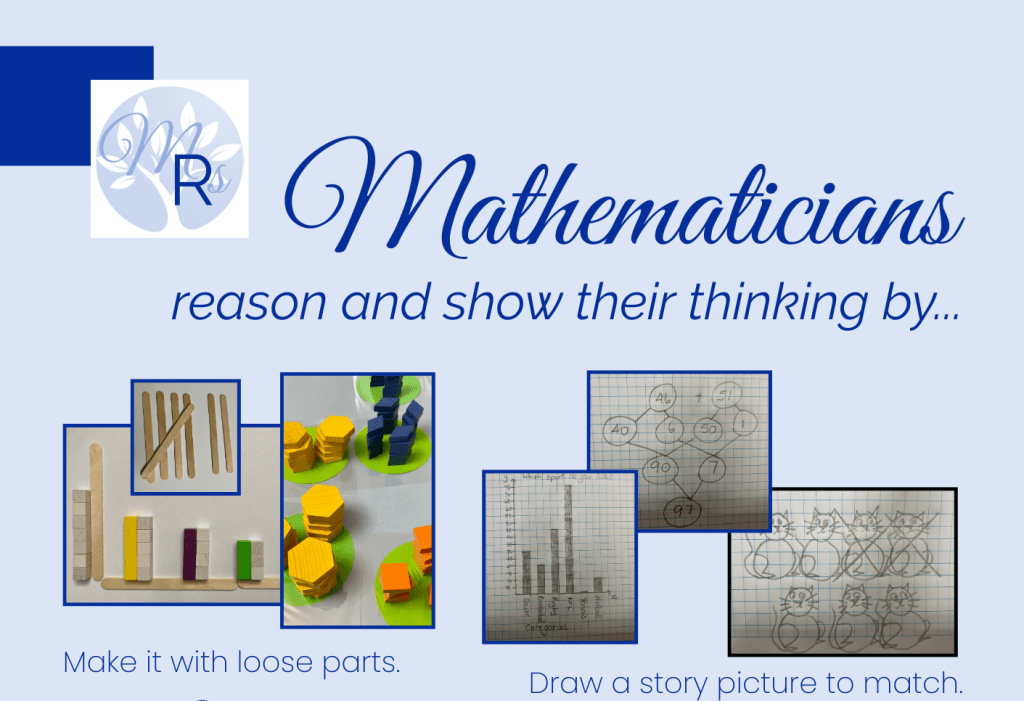
You’ve all heard it: “I don’t know how I got the answer, I just know”! You know the moment – that moment when a student is adamant they just know, but they can’t explain their thinking. I’ve had this many times, so I began producing anchor charts with children to be really explicit about what my expectations were when I asked them to show their reasoning.
At the beginning of a year, I’ll run through some of the options of strategies to reason one at a time and give students time to practise each strategy. I’ll develop a three level task that enables them to develop their ability to demonstrate the reasoning strategies at different levels. Starting with the most basic way to use the strategy at ‘Let’s Go!’ level (a basic entry point to practise the strategy), to develop it more at ‘Strive for Success!’ (developing it further with more challenge and at the level) and then to embed some kind of systematic thinking or justification into using that particular strategy at the ‘Mathematician!’ level (applying systematic thinking or justification beyond the level). This way, children can trial each strategy at a level that feels right for them, while the focus stays on reasoning. Revision tasks often become the vehicle for practising these strategies.
Once many reasoning strategies have been trialled, children will develop their favourites so I ask them to choose their desired way to reason. I’ll often ask them to show me in two or three ways. This provides kids with some autonomy and control over their learning choices and I find they engage well with more choices. It also provides a window into their thinking so that teachers can see how children are approaching problems. Students are also forced to use metacognitive strategies, or their thinking about thinking, to justify their choices.
Reasoning isn’t a natural skill, it takes time to practise and to develop. In fact, I’ve found it awesome to see what kids know and helps me with informative assessment and responsive teaching for the following day. I can then tell what the general understanding is of the room and plan appropriately. I’ve also found that the students learn from each other’s reasoning strategies during reflection times at the end of each lesson.
Some of the kids in my fractions lesson yesterday, were drawing models, some were making equal groups of counters on Brenax circles and using coloured counters to represent the focus fraction of the predetermined collection quantity and others used sentences to explain their thinking. They all shared their reasoning at reflection times and it was great to see the diverse methods used.
How will you develop your classroom expectations on reasoning? If you’d like a head start, sign up to my email list on my website at www.mrsrowntree.com.au and you will receive a free A3 printable reasoning anchor chart.
Happy reasoning!!
I’d love to hear how you encourage your students to reason, add your ideas into the comments below.

 Mrs Rowntree